
The Arisaka Rifle: Type 99


Beginning in the late 1930s, the Japanese military began moving toward the adoption of a new infantry rifle chambered for the 7.7mm cartridge. The 7.7×58mm cartridge had first been introduced for the Type 92 heavy machine gun and saw combat in China during the Second Sino-Japanese War. Japanese military authorities were impressed by the terminal performance of the 7.7mm cartridge compared with the 6.5mm ammunition used by the standard Type 38 infantry rifle.
Left: 6.5x50mm Type 38 rifle cartridge. Right: New 7.7x58mm Type 99 rifle cartridge.
In 1938, the Japanese Army Ordnance Department issued guidelines for modifying Type 38 rifles to chamber the 7.7×58mm cartridge. The purpose was to determine the practical feasibility of converting the existing rifle to the larger caliber. The Kokura Arsenal modified approximately 300 Type 38 rifles. Modifications included a new 7.7mm barrel and rear sight graduated to 2,000 meters, a modified receiver capable of accepting the longer cartridge from stripper clips, a lengthened magazine box, and an additional recoil lug in the stock to help absorb the increased recoil of the 7.7mm cartridge.
Ammunition was issued on 5 round stripper clips. Three clips were contained in each paper box.
The modified rifles were sent to the Futsu Proving Grounds in early 1938 for testing and evaluation. The results were encouraging, but the trials also demonstrated that converting existing Type 38 rifles to the larger cartridge was labor-intensive and expensive. If the Army was prepared to invest in a new rifle program, it made greater practical and economic sense to develop an entirely new rifle based on the proven Type 38 action while incorporating improvements in manufacturing and design that had emerged since the rifle's adoption in 1905.
Official requirements for the new 7.7mm rifle were issued in April 1938. Among other requirements, the rifle was to weigh no more than 8.8 pounds, have a rear sight graduated from 100 to 1,500 meters, use a lighter stock than the Type 38, and incorporate a simplified design that would make it easier and less expensive to manufacture. Two principal configurations of the new rifle were developed: the Type 99 Long Rifle and the shorter Type 99 Short Rifle, sometimes referred to as the "cavalry" version. The Long Rifle featured a 31-inch barrel, the same length as the Type 38, while the shorter rifle used a 25.5-inch barrel and was considerably more compact.

Both versions underwent extensive testing at the Futsu Proving Grounds, including technical trials and field evaluations. The final stages of testing were conducted by the Army's infantry and cavalry schools, where the rifles were handled by Japanese servicemen under realistic training conditions. The results were sufficiently positive for the Army to conclude that the new rifle was suitable for military service.

The Type 99 rifle was officially adopted in 1939, with production beginning in August of that year. As production expanded, the shorter configuration became the primary version of the Type 99 produced by Japanese arsenals and private manufacturers. The shorter rifle offered a more practical balance of barrel length, weight, and maneuverability for modern infantry combat while retaining the power of the 7.7×58mm cartridge.

The new Type 99 incorporated many of the best attributes of the Type 38, including the sliding dust cover. It was durable, dependable, and rugged, while retaining the same straightforward operating principles that had made its predecessor so successful. The Type 99's basic components, operation, and disassembly remained remarkably similar to those of the Type 38. However, the new rifle also introduced several improvements and features that distinguished it from the earlier design.
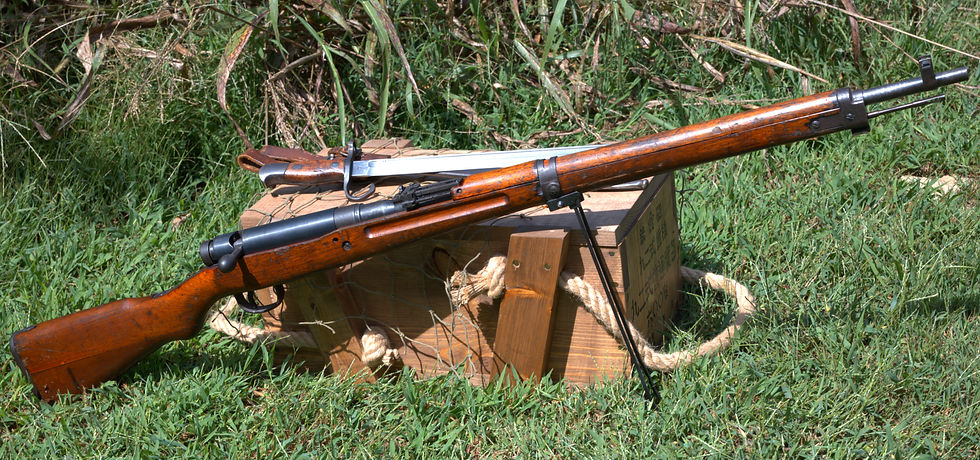
Among the most distinctive additions was a folding wire monopod incorporated into the rear barrel band. When deployed, the monopod provided the soldier with a more stable firing platform when shooting from the prone position. The rear sight also incorporated folding "wings" that served as rudimentary anti-aircraft sights.

While the concept may seem unusual from a modern perspective, the idea had some practical merit in the context of warfare in China during the 1930s. Japanese infantry units could use the sight wings to estimate the necessary lead when engaging slow-moving aircraft, particularly the relatively low-speed biplanes then commonly encountered in the Chinese theater. The rifle's elevation setting would be adjusted according to the estimated range to the aircraft, while the sight wings provided reference points for the required lead.

The concept was not intended to turn the individual infantry rifleman into an effective anti-aircraft gunner. Rather, it was based on the principle that a large group of soldiers firing simultaneously could place a considerable volume of rifle fire into the aircraft's flight path. When the aircraft reached the appropriate lead marker, soldiers could fire a coordinated volley in the hope of damaging the aircraft, forcing it to break off its attack, or discouraging further low-level operations.
Another important improvement was the addition of a hinged magazine floorplate. On the Type 38, the magazine floorplate was a separate component that could be removed from the trigger assembly by depressing a latch located just forward of the trigger. While this allowed easy access to the magazine spring and follower, it also created the possibility of accidentally dropping and losing the floorplate and spring, particularly under the difficult conditions of nighttime operations.

On the Type 99, the floorplate was retained by a hinge, allowing it to swing downward for access to the magazine and its spring while remaining permanently attached to the rifle. This simple change greatly reduced the risk of losing critical magazine components during field use. Other components of the Type 99 were similarly simplified to reduce manufacturing time and cost. Among these were the trigger guard and ejector housing, which were redesigned with simpler construction while retaining their essential functions.
Another significant improvement was the introduction of a chrome lined bore. The Type 99 rifle was among the earliest, and is generally regarded as the first mass produced military rifle to incorporate a chrome lined bore as a standard production feature. The chrome plating provided increased resistance to corrosion and simplified cleaning, an important consideration given the corrosive primers used in Japanese ammunition and the humid, tropical environments in which the rifle would eventually see extensive service. Many, if not most Type 99 rifles encountered today still feature nice rifle bores due to the use of chrome lining.
Chrome bolt face and bore. Chrome lining greatly extended the rifles service life by reducing corrosion. Chrome lining would also be discarded by the wars end.

The Type 99 rifle would serve throughout every theater of Japanese conflict, from the freezing mountains of China, to the sweltering jungles of the South Pacific. Like its predecessor, it was reliable and rugged, easy to maintain, and could be outfitted with the Type 30 bayonet, Type 100 and Type 2 grenade luanchers. Sniper variations of the Type 99 would also be produced by the Japanese during the Second World War as well as a specialty version for paratroopers that featured a removable barrel and forestock. This 'takedown' rifle would be designated as the 'Type 2'.

As the Second World War progressed, Japan's ability to manufacture weapons to the standards established before the war steadily deteriorated. The country's limited supplies of steel, copper, aluminum, chromium, and other strategic materials were increasingly consumed by the demands of a total war. Allied submarine warfare further compounded the problem by disrupting Japan's merchant shipping and restricting the flow of raw materials into the home islands. At the same time, Allied bombing increasingly damaged factories, transportation networks, and other industrial infrastructure. By the later years of the war, Japanese arsenals were under tremendous pressure to produce ever greater quantities of weapons with fewer materials, less time, and increasingly limited industrial capacity.
The Type 99 rifle was directly affected by these shortages. Features that had once distinguished the rifle, including the sliding dust cover, folding monopod, and chrome-plated bore, were progressively eliminated as production was simplified. These changes were not necessarily the result of the features being considered unnecessary; rather, they reflected the increasingly desperate need to conserve materials, reduce machining operations, and accelerate production. As the war continued, the Type 99 gradually evolved from a well-engineered military rifle into a weapon that could be produced as quickly and cheaply as possible.

By 1945, this process had reached its extreme. The rifles produced during this period are commonly referred to by collectors as "last ditch" rifles. Their rough machining, crude finish, and simplified components stand in stark contrast to the finely manufactured Type 99s produced earlier in the war. Chrome-plated bores had disappeared, machining was reduced wherever possible, and numerous small components were simplified or replaced with expedient alternatives. Even the rifle's safety illustrates this dramatic decline. An earlier Type 99 featured a carefully machined and knurled safety knob, while some of the latest examples used little more than a plain, flat metal cup with a crude welded blob at its center.

The sights were similarly simplified. Elaborate anti-aircraft wings and adjustable mechanisms disappeared in favor of simple fixed rear sights that could be produced with minimal machining. At the very end of the war, manufacturing standards had deteriorated to the point that even seemingly insignificant details reflected Japan's material shortages. Some of the final rifles were fitted with wooden buttplates secured with only two nails rather than the three normally used.
Late war Type 99 rifles display wooden buttplates secured with nails, rough machining, and lack chrome bores.
Despite the dramatic differences between the finely manufactured rifles of 1939 and the crude examples produced in the final months of the war, they were all fundamentally the same rifle. The Type 99 had begun as a deliberate evolution of the proven Type 38, incorporating a more powerful cartridge and a number of thoughtful improvements intended to meet the demands of modern warfare. It would ultimately become the standard Japanese infantry rifle of the Second World War and would serve Japanese soldiers across an enormous range of environments and battlefields.
The story of the Type 99 is also a reflection of Japan's experience during the war. Early examples demonstrate the capabilities of Japan's prewar arms industry and the considerable attention given to the rifle's design, manufacture, and serviceability. The increasingly simplified rifles of the later war tell a very different story. Each eliminated feature, roughened surface, and expedient component represented another step in Japan's struggle to maintain weapons production in the face of diminishing resources and overwhelming industrial pressure.

Today, the Type 99 remains one of the most recognizable Japanese military rifles of the Second World War. From the beautifully manufactured early examples with chrome-lined bores, dust covers, monopods, and sophisticated sights, to the crude "last ditch" rifles produced in the final days of the conflict, the Type 99 provides a remarkable physical record of the war itself. More than simply a rifle, it represents the technological ambitions, industrial capabilities, and eventual hardships of wartime Japan.


Comments