
Movie Review: The Thin Red Line (Spoiler: It Sucks)


The Thin Red Line sucks. I know that isn't the most unbiased or technical review of a movie, but it's the truth. Released in December 1998, The Thin Red Line follows Charlie Company of the 25th Infantry Division as its soldiers struggle with death, violence, the meaning of life, and the cruelty of man during the Battle of Guadalcanal in 1942.

The movie seems like it should have been a smash-hit war film, given its $52 million budget, star-studded cast, beautiful cinematography, musical score by Hans Zimmer, and impressive sound engineering. Unfortunately, the finished product comes across as pretentious, with very little character development and some rather questionable depictions of combat.
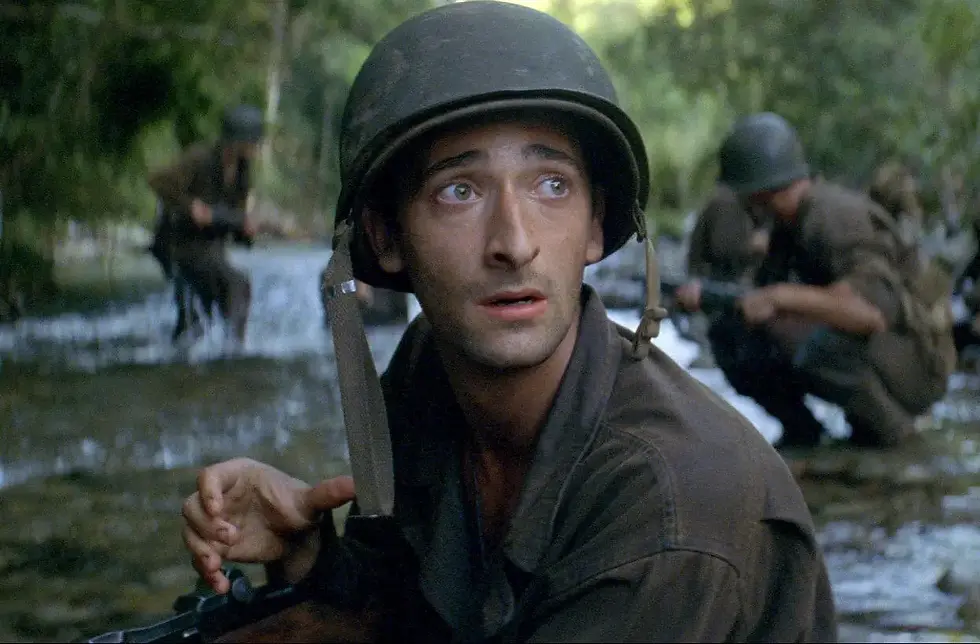
Shot primarily in Queensland, Australia, and the Solomon Islands, the movie is incredibly beautiful. The jungle scenes, wildlife, and scenery are absolutely stunning. The cinematography of this film cannot be questioned; it really is a visually impressive production. The depth and density of the jungle come through, as do the heat, grime, and mud that were constant companions to the American and Japanese fighting men on Guadalcanal. The film does an excellent job of showing just how overwhelming the tropical environment could be for the men fighting there.

The film features a huge cast of established Hollywood stars, including Sean Penn (Sgt. Welsh), John Cusack (Capt. Gaff), George Clooney (Capt. Bosche), John Travolta (Brig. Gen. Quintard), Woody Harrelson (Sgt. Keck), and Nick Nolte (Lt. Col. Tall).
It also features several actors who were still establishing themselves in Hollywood, including Adrien Brody (Cpl. Fife), who would go on to win the Academy Award for Best Actor for his performance in The Pianist in 2003. Other recognizable faces include Elias Koteas (Capt. Staros), Jim Caviezel (Pvt. Witt), Jared Leto (Pvt. Whyte), and John C. Reilly (Sgt. Storm).
While this long list of fantastic actors would seem to indicate that the film would deliver some powerful performances and well-developed characters, it actually leaves the movie feeling rather flat. With so many actors competing for screen time, there simply isn't enough opportunity to develop any of them. Many of the big-name actors have surprisingly little screen time and very limited dialogue. For example, George Clooney appears in a single scene near the very end of the film, essentially making a brief cameo. Adrien Brody has a much smaller role than audiences might expect given his presence in the film's opening portions. Much of his original material was cut during editing.
Director Terrence Malick clearly wasn't interested in making a traditional shoot-'em-up war movie. Instead, he opted to produce a deeply philosophical examination of war, humanity, and the meaning of life. The film constantly jumps between different characters, accompanied by endless voiceovers and pretentious internal monologues asking vague questions about existence, death, and the nature of man. There is certainly nothing wrong with trying to make a war movie that explores these subjects, but after nearly three hours, it becomes exhausting. At times, I found myself more interested in watching the scenery than listening to another character contemplate the meaning of life.

To the movie's credit, the uniforms, gear, equipment, and weapons are all fantastically done. Whoever was responsible for the set design and costumes clearly knew their stuff. The equipment worn and carried by the soldiers is generally appropriate for what was used by the U.S. Army during the Guadalcanal campaign. One detail that particularly caught my attention was the yellow Mk II fragmentation grenades seen throughout the movie. These are historically appropriate, as yellow was the identifying color for high-explosive ammunition, and the grenades were originally painted entirely yellow. It wasn't until October 1942 that the U.S. military ordered these grenades to be repainted olive drab, with a narrow yellow band around the top to identify their explosive filling. Aside from the accurate yellow paint, the grenades also feature the M10 series of fuses, accurate for 1942 MKII grenades. It's a small detail, but one that I always appreciate seeing correctly represented in a WWII film.
The Japanese soldiers are also well represented in regards to their uniforms and equipment. They feature a mix of Type 38 and Type 99 rifles, Type 92 and Type 96 machineguns. Their 3/4 sleeve khaki jungle uniforms, helmet nets, body nets, and puttees are all accurately represented. One nice detail is that the chin straps are also accurately tied under the chin.

Unfortunately, while the uniforms and equipment are satisfyingly accurate, the movements and tactics used by the soldiers are another matter entirely. There are several moments where the battlefield action feels staged for the camera rather than representative of how trained infantrymen would actually operate. The movement of troops, their use of cover, and some of the engagements leave quite a bit to be desired. I understand that this is a dramatic interpretation of a historical event, but why can't we have both an engaging storyline and reasonably accurate military tactics? One shouldn't have to come at the expense of the other.

Another shortcoming is that the movie does very little to explain the larger Guadalcanal campaign or why the island was so strategically important. For a film based on one of the most significant campaigns of the Pacific War, there is surprisingly little attention given to the broader military situation. Viewers are dropped into the middle of the fighting without much explanation of the campaign itself. The film is much more interested in what the soldiers are thinking than in explaining what they are actually fighting for.
Despite my complaints, The Thin Red Line was a financially successful film, grossing approximately $98 million worldwide against its $52 million production budget. It also received generally favorable reviews from critics, earning an 80% score on Rotten Tomatoes. Critics particularly praised the cinematography, sound engineering, and the film's philosophical approach to warfare. Gene Siskel considered it one of the finest contemporary war films he had seen, while Michael O'Sullivan of The Washington Post famously described it as "the thinking person's Saving Private Ryan." The film also received seven Academy Award nominations, including Best Picture and Best Director, although it ultimately failed to win any awards.
For me, however, all of the beautiful scenery, impressive sound, talented actors, and historically accurate equipment cannot make up for the film's shortcomings. At almost 3 hours long, it is simply too long, too slow, and too pretentious with philosophical monologues to keep my attention. I appreciate what Terrence Malick was trying to accomplish, and I can certainly understand why film critics and fans of his work hold it in such high regard. But as a WWII film, particularly one depicting the Pacific campaign, I found it disappointing.
Ultimately, The Thin Red Line is a beautiful film to look at, but not a particularly enjoyable one to sit through. If you're looking for a traditional WWII combat film, you're probably better off watching Saving Private Ryan. If you enjoy slow-paced, philosophical cinema with beautiful cinematography, you may find quite a bit to appreciate here. As for me, I'll take the combat scenes, military history, and storytelling of Saving Private Ryan any day. I rate it a 2/5 stars.


Comments