
The Arisaka Rifle: Type 38


Among the military firearms of the twentieth century, few rifles are as consistently misunderstood as the Japanese Type 38 rifle. Overshadowed by the later Type 99 and often dismissed in the decades following the Second World War, the Type 38 has nevertheless earned a quiet reputation among collectors, historians, and shooters as one of the strongest and most reliable bolt-action service rifles ever fielded.
Though it lacks the romanticism or finish of the German Mauser K98 or the iconic silhouette of the American M1 Garand, the Type 38 rifle remains an indelible symbol of Imperial Japan’s military modernization and expansion during the early twentieth century. Designed by a commission in 1905, the Type was officially adopted by the Imperial Japanese army in May of 1906 as the “Type 38 Infantry Rifle,” the designation derived from the thirty-eighth year of the Meiji Emperor’s reign. The rifle was developed at a time when Japan was rapidly emerging as a modern military power following its victory in the Russo-Japanese War.
Earlier Japanese service rifles, particularly the Type 30 and Type 35, had exposed several shortcomings during combat operations in Korea and Manchuria. Although the Type 35 had been a slight upgrade from the Type 30, its bolt was deemed to complicated, the rifle allowed to much debris to enter the action causing stoppages, and its dust cover must be manually opened and closed. Japanese ordnance officials sought a stronger, simpler, and more reliable replacement capable of enduring harsh field conditions while also improving accuracy and soldier confidence.


The resulting rifle was developed primarily through the work of Kijirō Nambu. Nambu had served under the guidance of Nariakira Arisaka at the Tokyo Arsenal. Although the Type 38 was largely Nambu’s design, the rifle family retained the “Arisaka” name due to its direct evolutionary lineage from the earlier Type 30 and Type 35 rifles originally designed by Arisaka. Today, most Japanese rifles, whether they are a Type 30, 35, 38, or 99, are colloquially known simply as the 'Arisaka'.
Chambered in the 6.5×50mm semi-rimmed cartridge, the Type 38 differed noticeably from many contemporary Western rifles that utilized larger calibers. To many observers, the Japanese cartridge appeared underpowered, particularly when compared to the American .30-06 Springfield or the German 7.92×57mm Mauser. Yet this criticism often ignores the realities of early twentieth-century infantry doctrine. The smaller 6.5mm cartridge generated relatively mild recoil, allowing soldiers to maintain better control during rapid fire while also reducing shooter fatigue. Japanese military authorities additionally valued the cartridge’s flat trajectory and practical battlefield accuracy.
Left: Military Spitzer style pointed ammunition. Right: Paper blank, wood blank, dummy, round-nose, and gallery practice ammunition.
The 6.5X50mm ammunition was originally developed alongside the Type 30 Arisaka rifle in 1897; however, problems with those rifles and their ammunition prompted the Japanese to modify the 6.5mm ammunition for use in the new Type 38 rifle. This new 6.5mm cartridge featured a 139gr (9g) flat base cupro-nickel bullet. It was propelled by 33gr (2.13g) of square flake nitrocellulose powder that achieved muzzle velocities of around 2,500 fps (760 m/s).

By 1915 the cartridge had undergone several modifications to improve accuracy. The powder charge was lowered to 30gr (1.94g), and the walls of the bullet were thickened in the front section of the bullet. These changes helped to improve accuracy and the additional weight to the front of the bullet created a tumbling effect upon impact.
Other cartridges for the Type 39 rifle were also developed, such as paper bullet blanks, low powered ‘gallery’ rounds with very short blunt nosed bullets for indoor or short-range target practice, wooden bullet grenade launching blanks, wood bullet blanks for use in the Type 11 machinegun, and dummy ammunition.
In service, the Type 38 quickly demonstrated its durability and reliability. The rifle incorporated a robust dual-lug bolt system with a large receiver ring and substantial steel construction. Decades later, firearms testing conducted by American ordnance personnel and civilian gunsmiths would reveal the remarkable strength of the Arisaka action, with many concluding that it compared exceptionally well against other contemporary military bolt-action designs.

Other features of the Type 38 rifle are the cleaning rod that stores inside the forend of the rifle, a ladder style rear sight, a dust cover that moves with the operation of the bolt, and an easily detachable magazine base plate.
The sights of the Type 38 are solid combat sights and consist of a sturdy inverted V front sight. Early production Type 38 front sights were unprotected, but later ones have protective ears on eitehr side of the front sight to prevent damage. The rear sight is a range adjustable folding ladder sight with an open V notch. With the ladder in the down position, the rifle features a battle zero of 400m. When in the upright position, the sights can be adjusted by using the sliding ladder from 400m out to 2,400m in 100m increments. While hitting an individual target at 2.4km is quite the stretch, remember that at this time volley fire was still very much standard infantry doctrine throughout the world, Japan included.
The Type 38 also featured a dust cover that moves back and forth with the action of the bolt. When closed, the dust cover effectively seals the action of the rifle against mud, dirt, and debris. Having the action clear of anything that might obstruct the operation of the bolt or get down into the workings of the rifle made for great reliability while in the field. Dust covers and Japanese rifles are greatly misunderstood by many collectors and enthusiasts. Even today, many people believe that the dust covers were noisy, ill-fitting, and often discarded by their Japanese masters. Nothing could be further from the truth, although that story is best left for another day…
Dust covers prvented dirt and debris from getting into the action. Note the two gas vent holes and notch cut into the stock.
The right side of the rifle stock also features a large notch cut just beside the rifles breech. This notch allows debris a place to go when the bolt is pushed forward into battery. If something were to get down into the crevices of the action, or between the stock and receiver, that debris would be pushed forward and out of the rifles action.
Among the Type 38’s most innovative features was its simplified bolt design, which placed a strong emphasis on safety. The safety cap fitted over the rear of the bolt body and fully enclosed the firing pin, ensuring that in the event of a ruptured cartridge case, escaping propellant gases would be directed forward and away from the shooter’s face. Two additional vent holes located just behind the breech further aided this system by channeling gas upward and away from the shooter.
The rear face of the safety cap featured aggressive knurling that provided a secure grip even in wet conditions, while the safety itself was large and easy to locate by touch. Together, these features made the rifle particularly easy to operate in darkness or while wearing gloves.

Field stripped Type 38 bolt and dust cover.

The Type 38 Arisaka bolt has a grand total of 5 large parts and disassembles in under a second with the twist of the rear safety cap. Compare that to the German K98’s 6 parts, two of which are quite small and could be easily misplaced or lost. The K98 bolt also requires a disassembly disk embedded into the rifles stock to fully disassemble the bolt for maintenance. The Type 38’s firing pin is quite large, making it robust; although, after decades of use and dry firing, it is common for firing pin tips to break off.
The extractor is large and thick, making for another reliable component. The extractor features a wide claw which allows it to grasp a larger surface area of the case rim, thus ensuring reliable extraction.
One of the rifle’s most distinctive features is its unusually long overall length. The standard infantry version featured a 31 inch (78.7 cm) barrel and measured over 50 inches (127 cm) in overall length, giving it a somewhat awkward appearance by modern standards. With the Type 30 bayonet attached, the rifle was 67 inches (170 cm) long, making the rifle just as tall or taller than many Japanese soldiers. However,

this length reflected the prevailing military thought of the early 20th century. Infantry doctrine across the world still emphasized volley fire and bayonet combat, and long rifles remained common among major powers before the First World War. The Type 38’s lengthy barrel also contributed to excellent ballistic performance from the 6.5mm cartridge. The rifles long barrel also reduces most muzzle flash, making the shooters position much harder to find at night.
Japanese soldiers carried the Type 38 across every theater in which Imperial Japan fought during the first half of the twentieth century. The rifle saw extensive use during the Siberian Intervention, and later throughout the war in China and the Pacific War. Even after the adoption of the more powerful 7.7mm Type 99 rifle in 1939, large numbers of Type 38 rifles remained in frontline service due to wartime production realities and logistical necessity.

The rifle’s service life extended well beyond Japan itself. At the outset of the First World War, Great Britain aquired several thoughsand Type 30 and Type 38 rifles primarily for naval use. Russia too made use of the Type 38 rifle to equip its forces. Many Russian Type 38s were captured by Finland, and later put into Finnish service.

Captured Type 38 rifles were widely reused throughout Asia, particularly in China, where Nationalist and Communist forces alike employed them during the Chinese Civil War. Some examples also appeared in Southeast Asia and Indonesia following the collapse of Japanese occupation forces in 1945. The widespread distribution of these rifles reflected both the enormous scale of Japanese wartime production and the practical reliability of the design.
Collectors today encounter the Type 38 in a wide variety of configurations and conditions. Standard long rifles remain common, though cavalry carbines and special variants often command significantly greater interest. One particularly fascinating aspect of Japanese rifles involves the imperial chrysanthemum, or “mum,” stamped atop the receiver. This sixteen-petal crest represented ownership by the emperor himself and symbolized the rifle as property of the Imperial Japanese state. Following Japan’s surrender in 1945, many surrendered rifles had the chrysanthemum ground off or defaced before being handed over to Allied forces.

Another defining characteristic of Japanese rifles is the extensive use of arsenal markings and series identifiers. Major arsenals such as Koishikawa, Nagoya, and Mukden produced large numbers of Type 38 rifles over several decades. Careful study of these markings can reveal manufacturing locations, inspection details, and even late-war simplifications. For collectors of Japanese militaria, these details often become as interesting as the rifle itself. Unfortunately, almost all production data on all Japanese rifles was destroyed in US firebombing raids during the Second World War. Today, only rough estimates can be made as to a rifle’s specific years of production.
The Type 38 also developed an undeserved reputation in the postwar years as an inferior rifle. Much of this misconception stemmed from poorly manufactured emergency-production rifles encountered late in the war, many of which were actually simplified Type 99 variants rather than Type 38s. American servicemen returning from the Pacific often brought back heavily worn or incomplete examples, further contributing to the notion that Japanese rifles were crude or unsafe.

In reality, Type 38 rifles were generally manufactured to a very high standard. The machining quality found on prewar examples can be exceptional, with smooth bolt operation, finely fitted components, and strong blued finishes. Japanese arsenals during the interwar years produced rifles that reflected both pride in workmanship and a growing industrial capability.

The rifle’s practical performance further reinforces its reputation. Shooters familiar with the Type 38 often remark upon its surprisingly soft recoil, excellent balance, and dependable feeding characteristics. The long sight radius and mild cartridge contribute to respectable accuracy even by modern standards. Ammunition availability has historically been a challenge for modern shooters, though commercial production and reloadable brass have made the rifle increasingly accessible in recent years. Ammunition producers such as Steinel and Graf & Sons regularly produce product runs of 6.5X50SR ammunition in several loadings.
Today, the Type 38 occupies an important place within both military firearms history and the broader study of Imperial Japan. It represents a transitional era in which Japan sought to modernize its military institutions while simultaneously pursuing imperial ambitions across East Asia and the Pacific. The rifle accompanied Japanese soldiers through decades of conflict, revolution, and occupation, becoming one of the defining weapons of the Imperial Japanese Army.
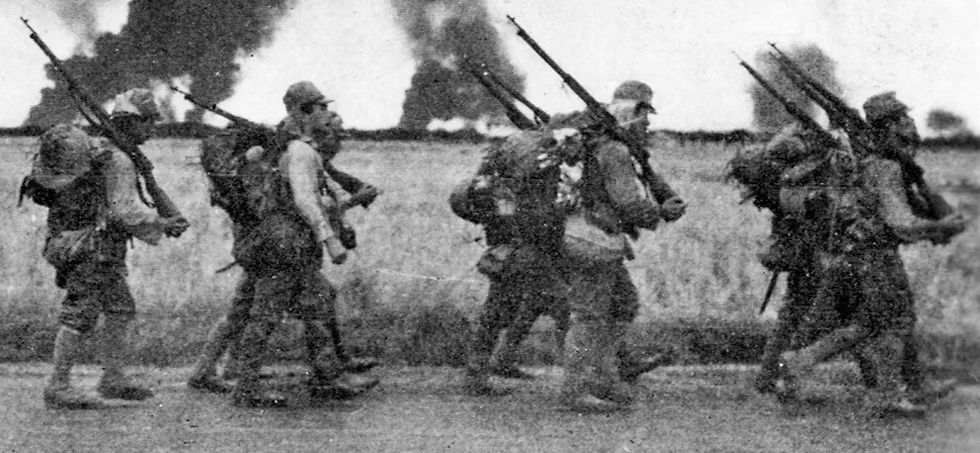
For collectors and historians alike, the Type 38 offers far more than a simple military surplus firearm. It is a tangible artifact of Japan’s emergence onto the world stage during the early twentieth century. Every arsenal stamp, unit marking, and worn stock tells part of the larger story, one of industrial modernization, imperial expansion, and the realities of warfare across Asia and the Pacific.
Though often overshadowed by more famous rifles of the era, the Type 38 deserves recognition as one of the most durable and historically significant bolt-action rifles ever produced. More than a century after its adoption, it continues to attract the interest of collectors, researchers, and shooters who appreciate not only its engineering, but also the complex history it represents.


Comments