
Sino-Japanese War Commemorative Compass Badge
- Patrick Phillips
- Feb 26, 2025
- 4 min read
Updated: Jul 30, 2025

In commemoration of the great Japanese victory over the Qing empire of China in the Sino-Japanese War of 1894-95, a commemorative compass badge was designed and distributed to veterans upon their return to Japan. The compass incorporates many different elements into its design and takes heavy inspiration from the Order of the Golden Kite. There are several variations of the badge, but they really only differ in minor variances in their details.
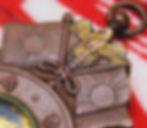
The badge is made of copper, with a round lower portion housing the compass in the center. The upper portion features two crossed Japanese flags: the Imperial Japanese Army regimental flag on the right and the Imperial Japanese naval ensign with fringed edges on the left. These flags are joined at the center by a knotted rope forming a bow, with tassels extending downward on either side.
Between the flags sits a gilded golden kite with its wings outstretched, gazing to the left. The bird is perched atop the Tamamaki no Ontachi (玉纏御太刀), a ceremonial sword adorned with jewels. The golden kite and the sword are symbolic elements drawn from Japanese mythology, frequently used to represent military bravery and devotion in Japan.
Above the kite is an eyelet and suspension ring for wear. Several examples have been seen with small pocket watch chains attached as well as braided cords. Only two images have surfaced showing veterans wearing the badge, and both of them show the soldier wearing the badge on a braided cord. However, it is unclear if these cords were provided with the badge, or purchased after the fact.

The front of the badge is adorned with a wreath of what appear to be chrysanthemum blossoms joined at the bottom with a bow. The glass of the compass is encircled by a decorative twist of copper, resembling ships’ line and serves to retain the compass within the body of the badge. The compass face is gold in color, and most badges have a black compass rose which is marked in all four cardinal directions of North (北, Kita), South (南, Minami), East (東, Higashi), and West (西, Nishi) in Japanese Kanji. Some badges lack a compass rose altogether and are simply marked with the cardinal directions. Some badges also include the intercardinal directions of Northeast (NE), Northwest (NW), Southeast (SE), and Southwest (SW) in English characters.

The reverse of the badge features two sets of Japanese text. The center text bears the Kanji characters “Blessing of the country” (國のいろは, Kuni no Iroha). The text around the perimeter of the badge reads, “Presented to the loyal and brave officers and soldiers engaged in foreign expedition” (忠良勇武ナル外征諸将士及ヒ兵員ニ贈ル, Chūryō yūbu naru gaisei sho shōshi oyobi hei-in ni okuru). This wording of the outer text left researchers and collectors with some ambiguity as to the specific campaign or conflict and was often associated with the Russo-Japanese War of 1904-05. With the recent discovery of photographs showing Japanese Sino-Japanese War veterans wearing the compass badge, in addition to the 1894-95 Military Service Medal (Sino-Japanese War Medal), it is the authors opinion that we can say without a reasonable doubt that these compass badges were intended specifically to recognize service in the 1894-95 conflict between China and Japan.


The compass badges were issued in matchbox-style cardboard boxes wrapped in white paper. Each box featured an inner sliding tray lined with cotton padding. The original packaging of the compass badges included a short leaflet inside the box describing the purpose and significance of the badge. These leaflets are very rare to find today, and read as follows:
“This compass is a gift from the emperor, bestowed as a token of encouragement and guidance. Since ancient times, the Golden Kite has been a symbol of divine favor, guiding warriors to victory in times of war. In the face of hardship and adversity, this compass shall serve as a beacon of loyalty, courage, and devotion to the emperor and the nation. Through dedication and unwavering resolve, let it guide you on the righteous path, ensuring success in all endeavors. May this gift inspire steadfastness and honor in the fulfillment of duty. By Imperial benevolence, this compass is grantedas a mark of distinction”


The label affixed to the box typically displayed the same wreath design as the badge; however, the flags were plain Japanese Hinomaru-style national flags, and the sword and kite were omitted.
At the center of the label, the word "gift" (贈呈, zōtei) appeared in large Kanji characters. Additional labels or stamps were often present on the reverse side of the box, indicating that these were manufactured by the Tenshōdō company in Tokyo’s Ginza district.
Founded in 1879, Tenshōdō originally specialized in selling name stamps and ink seals. By the time of the First Sino-Japanese War (1894–95), the company had become a leading importer of fine Swiss watches and jewelry. Today, Tenshōdō continues to focus on the imported watch and jewelry trade while also dealing in high-end model trains. In 2001, the company launched its own line of fine Tenshōdō watches.